what a phono stage does and why you might need one
Every vinyl system needs one exactly once. Miss it and the music whispers; use two and it shouts in all the wrong ways.
A turntable gives you one of the easiest ways in hi-fi to make a perfectly sensible system sound completely broken. Put its red and white leads into AUX and the music can arrive thin, distant and half audible however far round you turn the volume. Flick one switch, feed a stronger signal into PHONO instead, and it comes back loud, bloated and horribly distorted. The plugs fit in both places. The signal does not.
What is missing, or doubled, is the phono stage. Every vinyl system needs one and needs exactly one, and the confusing part is that it can be in any of three places: inside the turntable, behind the amplifier's PHONO sockets, or in a separate box between them. So before you buy anything, find the one you already own. Most turntable problems are not a bad component at all, they are this single job either missing or being done twice.
why vinyl gets treated differently
A cartridge is a very small electrical generator. The stylus follows the groove, that movement becomes a signal, and what comes out is far below the line level a streamer or a CD player sends. An ordinary AUX, CD or LINE input is expecting the stronger one, so a cartridge fed straight into it gives exactly the quiet, weightless result described above.
There is a second job hiding behind the gain, and it is the one people rarely hear about. Records are cut with the bass reduced and the treble lifted, following the standard relationship known as the RIAA curve, which is what allows the groove to fit on the record in the first place. On playback the phono stage applies the opposite curve, putting the tonal balance back where it was intended while it raises the signal to line level.
So a PHONO input is not simply another pair of RCA sockets with a helpful label. There is sensitive gain and equalisation sitting behind it. The word phono also gets used loosely for the RCA plug itself, which accounts for roughly half the confusion in this subject: an RCA-shaped socket is not a turntable input unless the equipment says it is.
the stage is hiding in one of three places
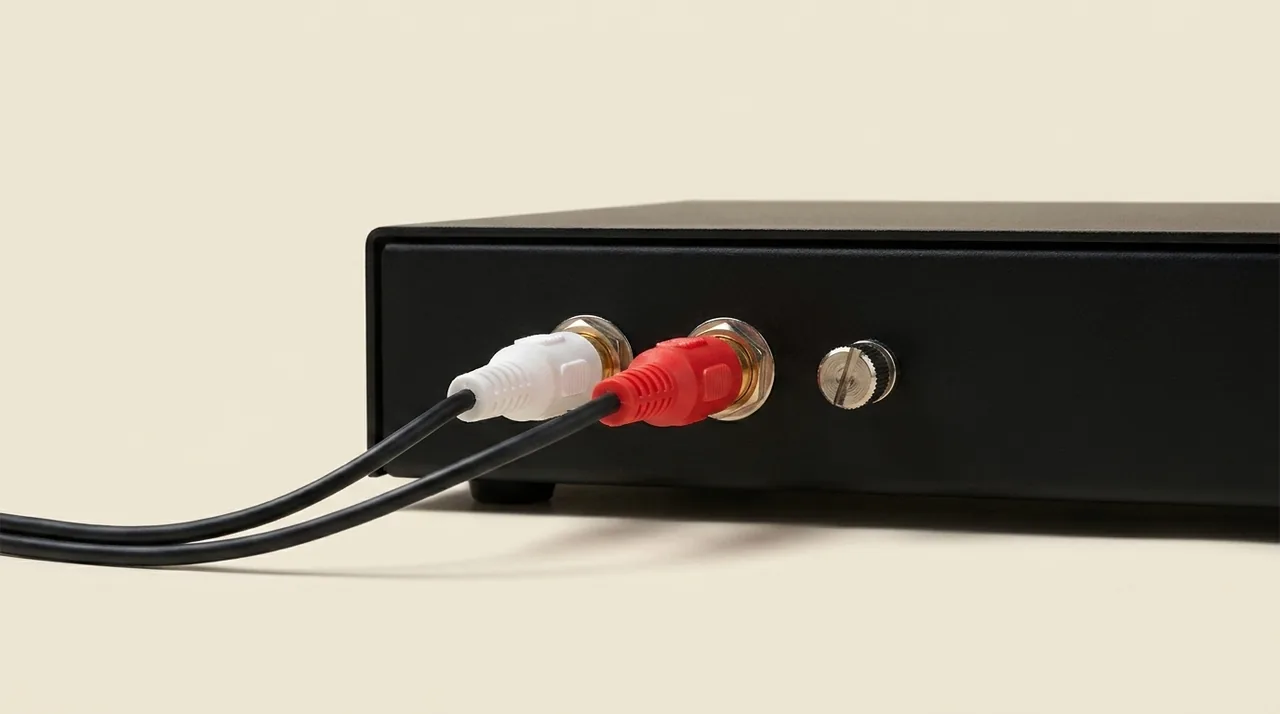
The traditional home is inside the amplifier. Look for PHONO, usually next to a small ground terminal, and check whether it supports MM, MC or both. A turntable sending phono-level output goes there, along with its separate ground wire where the deck provides one, and the amplifier hands the restored line-level signal on to its own volume and power stages.
A great many modern turntables put the stage inside the deck instead. A PHONO/LINE switch, or a setting described as preamp on and off, is telling you which signal is leaving the sockets. PHONO bypasses the internal stage and still expects one further down the chain. LINE uses it, so the deck can feed AUX, CD, LINE or the ordinary analogue input on a pair of powered speakers. The socket has not changed at all; everything electrically important behind it has. Our guide to connecting a turntable to speakers follows that path all the way to the speaker terminals, and how to set up a turntable covers the mechanical work before the signal ever leaves the deck.
The third home is a box of its own. The turntable goes into the phono stage's input, any MM or MC setting is matched to the cartridge, and the stage's output goes to an ordinary line input on the amplifier. It has already done the gain and the equalisation, so that output must never go back into PHONO. More boxes do not mean more stages in series. They mean one stage has been given its own case.
both mistakes announce themselves
When the stage is missing altogether, the music is very quiet and noticeably short of bass even with the volume much further round than usual. Do not keep turning it up in the hope that the speakers will eventually wake. Turn it down and trace the path instead: is the turntable set to PHONO, and if it is, where is the stage that is supposed to follow it?
When the stage appears twice, everything reverses. A turntable set to LINE going into an amplifier's PHONO input has already been amplified and equalised once before the amplifier does the whole job again, and the result is overloaded, tonally wrong and often startlingly loud. The same mistake happens when a separate phono stage is fed into PHONO instead of AUX or LINE. Turn down, move the connection, and start again gently.
Those two symptoms will tell you more than the colour of the plugs ever will. Quiet and thin means a stage is missing; loud and distorted means there are two of them. Hum is a related but genuinely different problem, and the ground-wire guide above deals with it.
MM, MC and the part the switch cannot solve alone
Finding one stage is not enough if it is the wrong one for your cartridge. Moving magnet cartridges, MM, generally produce more output than a low-output moving coil, MC. So an MM phono input cannot be assumed suitable for every MC design, and an MC setting may apply far too much gain, or the wrong loading, to an MM cartridge.
Some stages give you separate inputs or a switch, and others are MM only. High-output MC cartridges then complicate the tidy categories, because a number of them are deliberately built to work into an MM input. Read the cartridge's output and loading recommendation against the stage's specification rather than choosing on the strength of two letters. Gain, input impedance and, with MM particularly, capacitance all affect what you end up hearing.
Most straightforward MM systems need no adjustment at all once the right input is found. An unfamiliar MC cartridge deserves more care, because 'moving coil supported' can hide several different gain and loading choices behind it. Here the manual is not bureaucracy. It is the electrical match.
One practical difference follows the same split. A moving-magnet stylus is normally a separate part you unclip and replace yourself, while a low-output moving coil usually goes back to its maker instead. Our replacement stylus finder names the styli each cartridge we have checked will take, with the manufacturer's own document beside every answer.
built in or separate, and when the upgrade is real
A separate phono stage is not automatically better than one inside a turntable or an amplifier. A well-matched built-in stage can be quiet, convenient and entirely right for the cartridge in front of it, and moving the same job into another box guarantees an extra box and an extra cable without guaranteeing anything at all about the music.
A separate stage earns its place for real reasons. When there is no suitable stage anywhere in the system. When the input you have cannot support the cartridge you own. When adjustable gain or loading solves a genuine mismatch. When a careful, level-matched comparison shows a worthwhile improvement. It can also keep the vinyl path intact while amplifiers come and go. Start with the stage you already have, get the signal path correct, and identify the problem before you go shopping for its cure.
the two-minute checklist
Find the phono stage in the turntable, the amplifier or a separate box, and make certain it appears exactly once. Phono-level output goes to a PHONO input or an external stage; line output goes to AUX, CD, LINE or any other ordinary analogue input. Match MM or MC to what the cartridge actually asks for, connect the ground wire to its proper terminal where one is provided, and turn the volume down before you touch any switch. Quiet and thin, or loud and distorted, will tell you which of the two mistakes you have made.
So, do you need a phono stage? Yes, and you may well own one already. Once you know where it is, build the connection plan for your system and put every box and cable in order. The phono stage is not an optional vinyl upgrade; it is the translator between a record groove and the rest of your hi-fi. A WiiM Ultra in front of a Rega Brio MK7 is a system carrying two of them, and shows how to pick. Happy listening.