bi-wiring and bi-amping: what the four terminals are for
Four terminals and two metal links hide three ways to wire your system. What bi-wiring and bi-amping actually do, and whether either is worth the cable.
Turn a good pair of standmounts or floorstanders around, a Wharfedale Diamond 12.3 or a Mission LX-5 MKII for instance, and you may find not two binding posts but four, arranged as two pairs and joined by a pair of short metal bars or plates. Those bars are the clue to a question that puzzles a lot of people: why four terminals, and do I need two sets of speaker cables? The honest answer for most systems is no, but the four posts do open up two genuine techniques, bi-wiring and bi-amping, and it is worth knowing what each one does before you either ignore the terminals or spend money chasing them.
the four terminals, and the links that come fitted
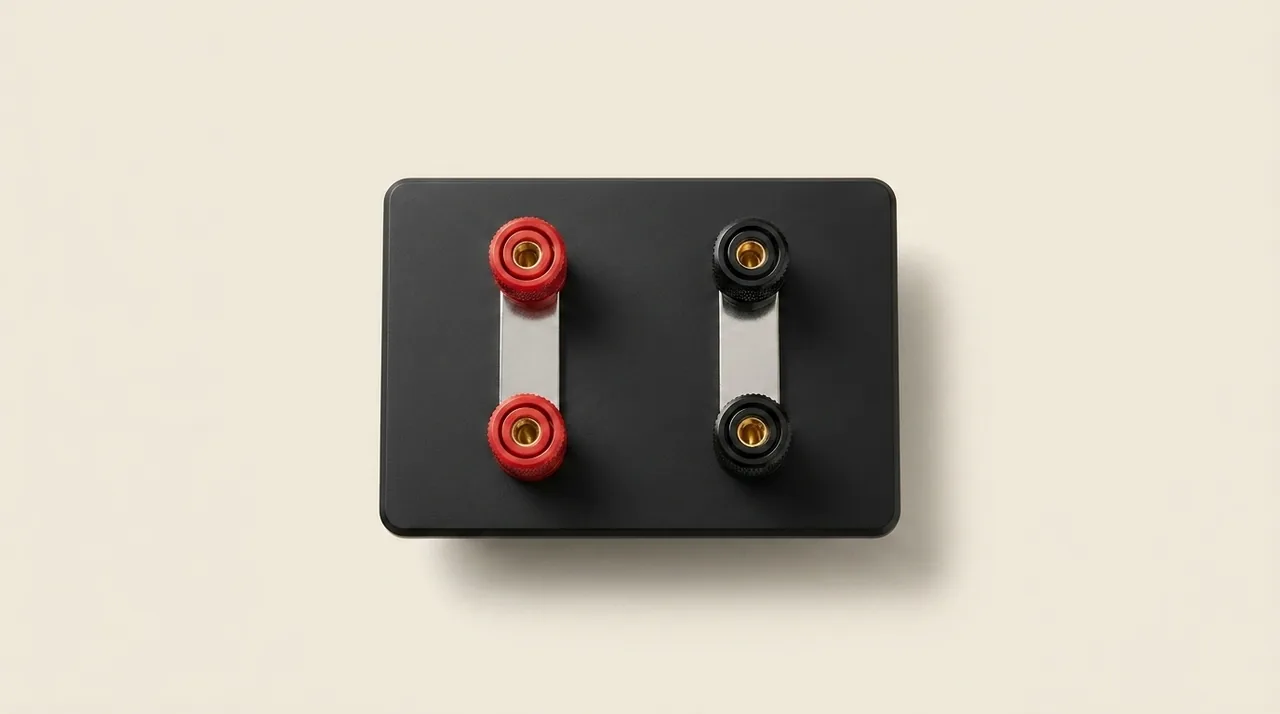
A loudspeaker with four terminals is described as bi-wireable. Inside it, the crossover, the network that decides which driver receives which frequencies, is split into two sections: one pair of posts feeds the bass driver, the other feeds the midrange and treble. Straight from the box the two pairs are joined by the metal links the maker supplies, which quietly reconnect the two halves into a single input. With those links in place the speaker behaves exactly like an ordinary two-terminal design, and a single pair of speaker cables drives the whole thing. The links matter far more than they look, and most of the confusion around bi-wiring comes down to what people do with them.
Do not try to predict this from the range name, because makers split their own ranges both ways. Wharfedale's Diamond 12 series gives four posts to the 12.1, 12.3 and 12.4 and two to the 12.0 and 12.2. Mission's LX MKII range is single-wired up to the LX-3 and bi-wireable from the LX-4 upwards. Rega's RX range gives every model a single pair. The only reliable answer is the back of the speakers in front of you, or their own manual.
single wiring: one cable per speaker, links left in
For the overwhelming majority of systems, single wiring is the right answer and no compromise at all. You run one pair of speaker cables from the amplifier to each speaker, connect them to either pair of posts, most people choose the lower bass pair, and leave the supplied links bridging across to the second pair. Connect red to red and black to black, and the speaker's own crossover does the rest. One mistake here catches people out, and it is worth stating plainly: if you remove the links but still connect only a single cable to one pair of posts, you disconnect half the speaker. Feed only the bass posts and the treble goes missing, feed only the treble posts and the bass vanishes, and in both cases the speaker sounds thin and wrong. When you are single wiring, the links stay in, always. Our walkthrough of a Diamond 12.3 system does exactly this, links left alone, on a real amplifier.
One good single cable, properly terminated, beats two cheap ones almost every time, so put a fixed budget into one better run rather than splitting it. Our speaker cable guide covers gauge, length and terminations, and the banana plugs, spades and bare wire guide covers how to finish the ends, both of which repay attention more reliably than a second run of wire.
bi-wiring: two cables, one amplifier
Bi-wiring keeps a single amplifier but gives each speaker two separate runs of cable, one to the bass posts and one to the treble posts, with the links removed. Both runs begin at the same single set of speaker terminals on the amplifier, so you're doubling the cable, not the amplifier. The reasoning behind it is that the large, constantly changing current the bass driver draws can modulate the tiny signal feeding the tweeter when both share one cable, and separating them into two cables is said to keep the treble cleaner.
Arcam make exactly that case in their own manual, saying bi-wiring avoids the signal distortions that arise when high and low frequency currents interact within a single cable. That is a manufacturer's claim rather than a measurement, and opinions divide sharply over whether it is audible at all, let alone worth the second lead. Our guide to whether cables affect sound sets out where that kind of reasoning holds up and where it runs out.
You can do it with two identical runs of ordinary speaker cable, or with a purpose-made bi-wire cable, which is a single cable at the amplifier end that splits into four tails at the speaker end to keep things tidy. Whichever you use, remove the links first, then take both runs from the same red and black terminals on the amplifier and connect red to red and black to black at all four posts on the speaker.
bi-amping: two amplifier channels per speaker
Bi-amping goes a step further and gives each speaker two amplifier channels, one for the bass section and one for the treble, again with the links removed. It comes in two quite different forms. The everyday version is passive bi-amping: two channels of amplification per speaker, fed from the same signal, with the speaker's own crossover still doing the actual frequency splitting. The gain is modest, mainly a little more current and headroom because each amplifier now drives only half the load. You need two pairs of speaker cables per speaker, one run from each amplifier channel to its pair of posts, and the links must be out.
In practice that means a second amplifier, and this is where the A and B speaker terminals on an integrated amplifier become a trap, because they look like two amplifiers and almost never are. Cambridge describe the CXA81's Speaker B as somewhere to run a second set of speakers in another room, and that manual does not mention bi-amping anywhere. Arcam are blunter still about the DiVA A85: connect two pairs and the loads combine, which is why they require each pair to be rated between 8 and 16 ohms and warn that the overload protection engages, and the amplifier will not work, if the combined load falls below 4 ohms. Terminals that share one output stage like that cannot bi-amp anything.
Arcam do document the real thing for the same amplifier, and it shows what the technique actually asks for. Two amplifiers, in their example the A85 and an Arcam P85 power amplifier. An interconnect from the A85's PRE OUT to the power amplifier's input so both see the same signal. The integrated driving the HF terminals on the speakers and the power amplifier driving the LF. Two boxes, two pairs of speaker cable per side, and the links out first.
The serious version is active bi-amping, where an electronic crossover placed before the amplifiers splits the signal into bass and treble first, each amplifier then receives only its own band, and the speaker's internal passive crossover is bypassed altogether. It can be genuinely transformative, but it is a specialist undertaking: the amplifiers must be gain-matched, the crossover set correctly for the exact speaker, and the speaker must allow its passive crossover to be bypassed. Few domestic speakers are built for it, so treat active bi-amping as an enthusiast's project rather than a casual upgrade.
A caution shared by both bi-amping methods, and Arcam put it more sharply than we would: removing the terminal links is essential, or damage may result that is not covered under warranty. Leave them in and you join two amplifier outputs together through the speaker, which at best defeats the exercise. Before any of that, confirm from your own amplifier's manual that its two sets of terminals are genuinely separate channels rather than one output stage switched to two sockets. If the manual states a combined impedance rule for using both pairs at once, that is your answer, and the answer is no.
so which is worth doing?
For most people, single wiring with one well-chosen, well-terminated speaker cable is the sensible destination, and the four terminals can simply keep their links. If you already own a spare run of cable and the curiosity, bi-wiring is a harmless experiment with a small possible reward. Passive bi-amping earns its place when a second power amplifier is already sitting there and you want a touch more grip and headroom on demanding speakers. It isn't a reason to buy one. Active bi-amping is a rewarding rabbit hole for those who enjoy the engineering. None of these will rescue a poorly matched system, and all of them come a distant second to getting the speakers well positioned in the room. Our amplifier matching guide deals with the pairing itself, and how to position stereo speakers turns the placement into something you can repeat.
the two-minute checklist
Four posts and two link bars? Your speakers are bi-wireable. Single wiring: one cable per speaker, links left in, connected red to red and black to black. Never remove the links and feed only one pair, you will lose half the speaker. Bi-wiring: links out, two cable runs per speaker taken from the same amplifier terminals, or a proper bi-wire cable. Passive bi-amping: links out, and a second amplifier, because the A and B terminals on an integrated are usually one output stage switched to two sockets rather than two channels. Match polarity at every post. And if you are unsure how your speakers and amplifier want to be joined, add them to the planner and it will lay out the connection for you.
Four terminals, two links, and three ways to wire them, yet for most systems the simplest is also the best. Choose good cable, leave the links in, and get on with the music. Happy listening.